ISSN: 2158-7051
====================
INTERNATIONAL JOURNAL OF
RUSSIAN STUDIES
====================
ISSUE NO. 10 ( 2021/1 )
|
|
ISSN: 2158-7051 ==================== INTERNATIONAL JOURNAL OF RUSSIAN STUDIES ==================== ISSUE NO. 10 ( 2021/1 ) |
QUANTITATIVE SPATIAL ANALYSIS OF THE TERRITORIALITY OF RELIGIOUS STRUCTURES IN TATARSTAN, RUSSIAN FEDERATION
MATTHEW DERRICK*
Summary
This paper investigates the territoriality of religious structures in Tatarstan, a semi-autonomous republic of the Russian Federation, using government data from 2010. Although the region is populated in roughly even numbers by Sunni Muslim Tatars and Orthodox Christian Russians, it is host to a far greater number of mosques (more than 1,100), their construction largely bankrolled in the 1990s by a political elite that pursued an aggressive sovereignty campaign, than churches (fewer than 300). In fact, Tatarstan, in spite of the titular Tatars’ comparatively low level of religious observance, by a wide margin claims a greater number of officially registered mosques (both as a gross total and as a ratio of its Muslim population) than any other Muslim-majority region of Russia. Drawing on two sets of data—one on the ethno-national structure of Tatarstan at the district (raion) level, the other a database containing separates lists of all officially registered mosques and Orthodox churches in the republic—I conduct Geographic Information Systems-enabled analysis to show the spatial distribution of mosques vs. churches and their correlation to the spatial distribution of Muslims vs. Orthodox Christians in the republic.
Key Words: Territoriality, Tatarstan, mosques, churches, Islam, Orthodox Christianity, spatial analysis.
Introduction
In
this paper I analyze the territoriality of religious temples in contemporary
Tatarstan, a semi-autonomous republic of the Russian Federation that is
populated in roughly even numbers by Sunni Muslim Tatars and Orthodox Christian
Russians.[1] I quantitatively survey
the spatial distribution of mosques vs. churches in the region and their
correlation with demographic indicators. Most important in a region, and
country, where religious affiliation highly corresponds to ethno-national
identity,[2] is to discern the
relationship between the location and number of mosques vs. churches and the
ethnic make-up of the area, seeking to answer questions such as the following:
Is there a significantly greater (or lower) number of mosques in areas home to greater
(or lower) ethnic diversity? For instance, in parts of Tatarstan inhabited
almost exclusively by Muslim Tatars, might the number of mosques per capita be
lower? Or, conversely, in areas host to relative ethnic parity, might the
number of mosques per thousand Tatars be greater?
This
paper represents a part of a broader, ongoing research project in which I
examine how political-territorial restructuring has influenced the character of
Islamic revivalism in Tatarstan and other Muslim-majority regions of the
post-Soviet realm.[3]
More specifically, I explore how and why, beginning in the early 1990s, the
political and national elite of Tatarstan encouraged the development of a
secular-leaning, reform-minded Islam (known as Jadidsm,
from Arabic for “new way,” or alternately as Euro-Islam) that corresponded to
their understanding of Tatarstan as the Tatars’ sovereign homeland, a
nation-state on the Western European model.[4] With the recentralization
of the Russian Federation that has been accomplished following Vladimir Putin’s
ascendance to the Kremlin, however, the political establishment of Tatarstan
has shifted its support to more conservative Islamic practices deemed
“traditional to Russia.” The current communication and reinforcement of an
“official” Tatar Islam, above all loyal to the state (piquing the question, considering
Kazan’s aggressive sovereignty campaign of the 1990s, which state?),[5] simultaneously
marginalizes Muslims in the region who adhere to more universalist
conceptualizations of Islam, i.e. Wahhabism or Salafism—decried as foreign,
fundamentalist, and extremist by local authorities—and alienates certain vocal
segments of the Tatar national movement who, as they retain their vision of an
independent Tatarstan, increasingly frame their territorial demands in an
Islamist register.[6]
Central
to this paper, as well as my broader research project, is the concept of human territoriality, “a primary
geographical expression of power,” according to geographer Robert Sack, who
defines the term more fully as “the
attempt by an individual or group to affect, influence, or control people,
phenomena, and relationships, by delimiting and asserting control over a
geographic area.”[7] Sack emphasizes that
territoriality is not an essential part of human behavior, unlike with animals,
but rather a learned “strategy” through which power relations are reified via a
threefold process of (1) classification
of space, e.g. “homeland” vs. “foreign land,” “ours” vs. “not ours”; (2) communication of a sense of place, e.g.
the erection of boundaries; and (3) enforcement
of control, e.g. policing, surveillance.[8] Following from this
dynamic, the usefulness of territoriality as a control-oriented strategy lies
in its efficiency: Power relations are depersonalized by moving attention away
from individuals and to the entire extent of a bounded space. Hence,
territoriality shapes group identity in its role of defining group membership,
literally who is considered “in” and who is “out” of place.
In
an earlier article, I examined how preferred understandings of Islam and
homeland—shifting along with the territorial restructuration of post-Soviet
Russia—are communicated and reinforced via the Muslim Spiritual Board of the
Republic of Tatarstan (DUMRT), a centralized ecclesiastical institution charged
with monitoring the activities of all mosques in the region,[9] which in 2010 numbered
more than 1,100, up from only 18 in the late perestroika era.[10] A number of observers
have commented on the remarkable growth in the number of mosques in post-Soviet
Tatarstan as evidence of a singular Islamic revival that grows in intensity and
complexity in the region.[11] Left unexamined, however,
is the territorial logic behind the boom in mosque construction in Tatarstan.
Of the current figure, about 1,000 mosques were in operation by the end of the
1990s, when Tatarstan was widely viewed as de
facto sovereign[12], and of that number about
70 percent were in various stages of construction already by the end of 1992.[13] This sharp spike came in
spite of the fact that, aside from religious holidays—viewed as national holidays by Tatars in the
context of their national revival in the early 1990s—and family events (e.g.
traditional wedding ceremonies, circumcision rituals, etc.), the newly opened
mosques for the most part remained empty throughout the 1990s.[14] As my previous research
suggests, the rapid construction of mosques in the wake of perestroika, financed almost exclusively by Kazan-based political
authorities,[15]
should be viewed not simply as a reflection of the Tatars’ renewed religious
freedoms, but more so as an act of territoriality. The rapid growth in mosques
in the early 1990s can be understood as part of a campaign by Kazan’s political
and national leadership to Tatarize the republic’s
landscape, to communicate boundaries in line with the vision of Tatarstan as
the Tatars’ namesake nation-state, and thereby articulate more sharply what
geographer Anssi Paasi
terms the “symbolic shape” of territory.[16] As a comparison, fewer
than 200 Orthodox churches—less than one-six the number of mosques—have been
restored or constructed in the region.
The
aim of this paper is to complement my previous narrative-based approach with an
approach based on quantitative spatial analysis to examine the territoriality
of mosque construction. Approaching this question quantitatively is important
because, as human territoriality is a
controlled-based strategy, the patterns and relationships that emerge through
spatial-statistical analysis offer the potential to bring to the surface
previously unrecognized intentions of the political elite of Tatarstan who
bankrolled the region’s mosque construction. The geographic Information Systems
(GIS)-enabled spatial-statistical analysis in this paper primarily draws on two
data sets. First is a 2009 database of Muslim and Orthodox organizations/communities
(prikhody),
i.e. mosques and churches, which I obtained from Tatarstan’s Council for
Religious Affairs (CRA). Second is a 2004 database titled “National Structure
of the Population of the Republic of Tatarstan,” which I obtained from the
State Statistics Committee of the Republic of Tatarstan.[17]
The
Social Scientific Study of Religious Temples
Academic
geographers and other social scientists have studied the significance of
religious temples. An early, well-known contribution to this literature is
David Harvey’s examination of the Basilica of the Sacred Heart in Paris and the
manner in which it has contributed to French national consciousness while
covering over a history of class-based conflict.[18] The construction (or
reconstruction, as the case may be) of religious structures in post-Soviet
Russia, in light of its recent history of militant atheism, has attracted
considerable scholarly attention. For example, Dmitri Sidorov
studies the resurrection of the Cathedral of Christ the Savior in Moscow as
part of the country’s post-socialist nation (re)building.[19] Political scientist Kate
Graney’s analysis of the Kazan Kremlin, where one of Europe’s largest mosques—
its construction completed in 2005—shares a common, highly symbolic space with
a sixteenth-century Orthodox cathedral, is particularly relevant to my
research.[20]
She interprets this landscape, with the two temples holding prominent positions
side by side within the Kremlin, as a being framed as a “concrete reminder of
the Russian Federation’s essentially multi-ethnic, multicultural nature.”[21] In the context of
contemporary Istanbul, geographer Amy Mills investigates a neighborhood deep in
the process of gentrification to illustrate how representations of an Armenian
church and a synagogue, although obscuring a violent history of minority
persecution, are today narrated as evidence of the Turkish nation’s
cosmopolitanism and multicultural tolerance.[22] Common to these and other
high-resolution, narrative-based studies[23] is a focus on the
manipulations of political elites that are often involved with the construction
and/or reconstruction of prominent religious structures and the (often
contested) relationship to group identity.
Other
scholars have gone beyond single-case studies in the attempt to formulate
generalizations on the locational aspects of religious structures and their
significance in multi-confessional contexts. For example, geographer Chad
Emmett, drawing on several case studies in various geographic and historical
contexts, analyzes how the siting of mosques and churches can provide insight
into the degree of tolerance or intolerance in a given society.[24] Likewise drawing on
multiple case studies, anthropologist Robert Hayden sets forth to challenge
what he characterizes as the “simplistic assumptions” that the coexistence of
temples belonging to different faiths is an indicator of pro-pluralist
tolerance. Instead, he develops the concept of “antagonistic tolerance,”
contending that “coexistence may be a matter or competition between members of
different groups manifesting the negative definition of tolerance as passive
noninterference and premised on a lack of ability of either group to overcome
the other.”[25]
Hayden in particular deserves recognition for debating basic questions of
“tolerance” vs. “intolerance” in places host to religious diversity. However,
his analysis not only bears strong traces of essentialism, but also is redolent
of narrative-based, micro-scale analysis in at least one aspect: He relies on
single-site cases, although collected from various geographical and historical
contexts and examined comparatively, rather than investigating (in a
quantitative manner) broader geographical patterns of coexistence and/or
exclusion.
Tatarstan
in Comparison
Among
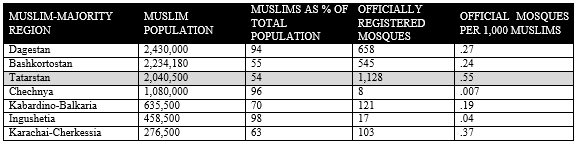
Russia’s seven Muslim-majority regions, Tatarstan is home to the third-largest
ethnic Muslim population, numbering just over two million (see Table 1). Unlike
Dagestan, Chechnya, and Ingushetia in the North Caucasus, where populations
almost entirely identify with Islam, Tatarstan’s ethnic Muslim population forms
only a slight majority (54 percent), with ethnic Russians (nearly 40 percent of
the republic’s population) and other traditionally Orthodox Christian ethnic
groups accounting for virtually all of the remainder. Tatarstan is similar to
neighboring Bashkortostan is this regard, as well as in total number of ethnic
Muslims; however, unlike in Bashkortostan, where the umma (community of
Islamic believers) is split between Bashkirs (51 percent of the republic’s
Muslim population) and Tatars (45 percent), Tatarstan’s Muslim population is
comprised almost exclusively of Tatars, the republic’s titular ethno-national
group. In this manner, Islam in Tatarstan is closely associated, almost
synonymous, with Tatarness, and vice versa, as has
historically been the case in the region.[26]
TABLE
1: Comparison of Muslim-majority regions of Russian Federation
Data compiled from the 2002 All-Russian
Census of Population; R.A. Silant’ev, Islam v Sovremennoi Rossii. Entsiklopediia (Moscow: Algoritm,
2008); http://tatarstan.ru/eng/about/religion.htm; and http://islamio.ru/
In part as a result of having been
brought into the Russian Empire much earlier than the peoples of the North
Caucasus, Volga-area Muslims have been subjected to a greater degree to the
forces of modernization, attested to by higher rates of industrialization and
urbanization, as well as lower birth rates, etc.[27] In line with
modernization theory, previous research indicates that Muslims of the Middle
Volga Basin are significantly less active in their religious beliefs and
commitments than their counterparts in Russia’s far south. For example, Lehmann
presents survey data illustrating that, whereas Muslims in Chechnya and
Dagestan actively practiced their faith at rates of 71 percent and 51 percent, respectively,
only 21 percent of Tatarstan’s titular group were active in their religiosity;
for Bashkortostan, the figure stood at 17 percent.[28] Whereas only 9 percent of
Dagestan’s Muslims self-identified as “atheists,” and no Chechens claimed
unbelief, 30 percent of the titular groups in both Bashkortostan and Tatarstan
described themselves as “atheists.”[29] Focusing on the Tatars of
Tatarstan, Musina’s examination confirms that “only a very small number” of the
republic’s Muslims are observant of even the most basic tenants of Islam; for
instance, she cites survey data from the early 1990s revealing that only 8.3
percent of urban Tatars of Tatarstan performed even home prayer.[30]
These basic contours of active
religiosity among Russia’s Muslim groups are not matched by tallies of
officially registered Muslim communities (i.e. mosques). Tatarstan, where
religious observance is comparatively low, by a large margin registers the
greatest number of Muslim communities, several hundred greater than
comparatively highly religious Dagestan. Tatarstan is also the leader in the
number of officially registered Muslim communities as a ratio to population,
with .55 mosques for every 1,000 Muslims; Karachai-Cherkessia,
with only about one-eighth of the population of Tatarstan, comes in a distant
second place, with a ratio of .37 mosques per 1,000 Muslims. Observers
generally agree that official mosque counts for Dagestan, Chechnya, and
Ingushetia do not reflect reality. Silant’ev, for
example, puts the number of mosques in Dagestan “at a minimum three times
higher” than the official figure, a discrepancy in part reflective of the
growing popularity of Wahhabism, Salafism, and other forms of the religion
unwelcome by regional authorities intent on protecting only Islam considered
“traditional” to the area.[31] He also estimates 450 to
500 mosques operate in Chechnya,[32] while the “real number of
Muslim communities is at least two times greater” than the official figure in
Ingushetia.[33]
With these readjusted figures, Dagestan would surpass Tatarstan, in both gross
and (although marginally) ratio terms, although Chechnya and Ingushetia would
not. Perhaps more striking, though, is the comparison to neighboring
Bashkortostan, where Muslims are roughly equal in number, they comprise an
almost exact proportion of the population, and they traditionally follow the
same type of Islam as followed in Tatarstan. The main difference, again, is
that Tatarstan’s umma is mono-ethnic,
while Bashkortostan’s Muslim population is divided between Bashkirs and Tatars.
Nonetheless, in spite of the similarity of these profiles, Tatarstan is home to
greater than twice as many officially registered Muslim communities.
Data
Overview: Description and Issues
Analysis in this paper draws on two
data sets. The first, obtained in October 2009 from Council for Religious
Affairs (CRA) of the Cabinet of Ministers of the Republic of Tatarstan in
Kazan, is comprised of two separate lists of all officially registered Muslim
and Orthodox Christian organizations/communities (prikhody) in Tatarstan. This data
presents some challenges in conducting subsequent analysis. The first challenge
arises due to the diverging geographic-administrative levels at which they were
collected. For officially registered Orthodox Christian communities, precise
locational information is given; each is listed by district (raion), as well
as city (gorod),
settlement/town (posiolok),
or village (selo).
For officially registered Muslim communities, however, data is presented at the
administrative level set by the Muslim Spiritual Board of the Republic of
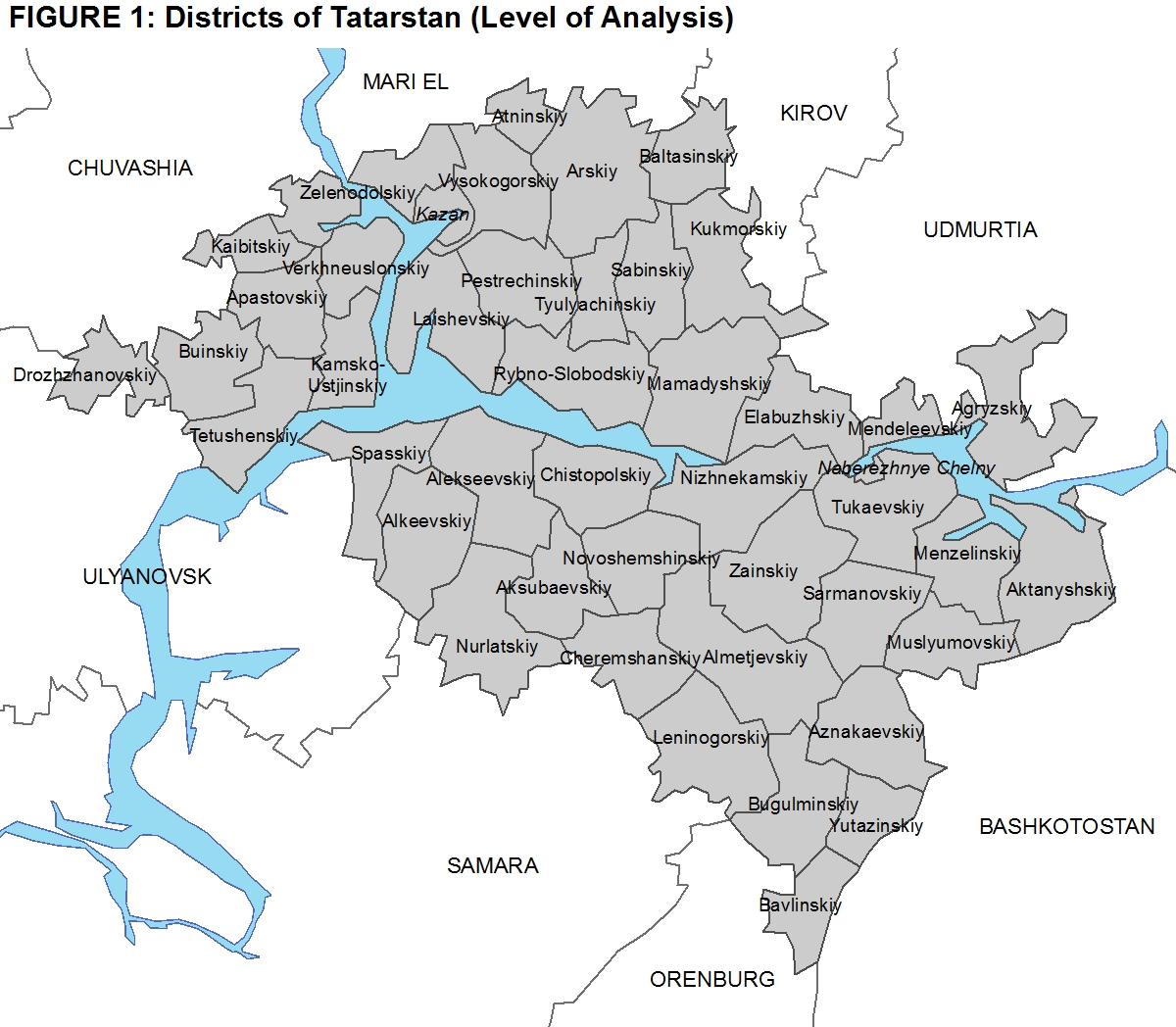
Tatarstan (DUMRT), consisting of 45 regional units (called mukhtasibaty) that for the most part replicate the republic’s political
districts (raiony)
(see Figure 1). Of the 45 mukhtasibaty, 43 are sub-regions of Tatarstan and the
remaining are the republic’s two largest cities, Kazan (population 1.1 million)
and Naberezhnye Chelny
(population .5 million) (see map below). A problem with this data is that,
beyond classification of which administrative district each mosque belongs,
there is no further locational information, i.e. no exact city,
settlement/town, or village is given. In light of these scalar issues, it was
necessary to conduct analysis at the administrative district (mukhtasibat) level set by DUMRT, which, again, is
largely coterminous with the political districts (raiony) of the republic.
A
second issue connected with the database on religious communities is the
question of classification and counting. The classification of a Muslim
organization/community (prikhod)
is fairly straightforward: Each individual mosque is generally classified and
registered as a separate community. However, even here, there appears to be a
discrepancy. The list of Muslim communities for each of DUMRT’s administrative
district (mukhtasibat)
obtained from the CRA totals 1,247 mosques, yet an addendum on the document
states that, as of October 2009, only 1,098 Muslim organizations were
officially registered with the state agency.[34] For officially registered
Orthodox Christian organizations, the situation is more complex. The total of
291 organizations listed in the database obtained from CRA, in addition to
“cathedral” (sobor) and “church” (tserkov’), also includes organization/community
classes such as “monastery” (monastyr’),
“chapel” (chasovnia),
“hermitage” (pustyn’), and even “wellspring” (istochnik).
Moreover, multiple objects of individual monasteries are each classified as
separate religious organizations; for example, a single monastery in the Zelenodolskiy district is classified as having seven
separation religious communities/organizations, including two cathedrals, four
churches, and the monastery itself. An attempt to create a semblance of parity
between Tatarstan’s two main faiths, this case of organizational inflation
likely comes as a result of widespread complaints, beginning in the latter part
of the 1990s, of the Kazan-based government heavily favoring the
construction/reconstruction of mosques while neglecting Orthodox religious
structures and compounded by the overriding tendency of political-territorial
recentralization of the Russian Federation in the Putin era.[35] In spite of these
discrepancies, analysis is based on the full list of organizations provided for
each religion in the Tatarstan (for Muslim communities, n = 1,247; for Orthodox
Christian communities, n = 291).
The second database upon which
analysis is conducted is a 2004 publication of the State Statistics Committee
of the Republic of Tatarstan titled “National Structure of the Population of
the Republic of Tatarstan.” Built from the final results of the 2002 All-Russian
Census of Population, the database is comprised of information on the national
structure of the urban and rural population for all cities of federal
significance (n = 15), each in itself comprising a district (raion),[36] and sub-regional
districts (raiony,
n = 43) of Tatarstan. Total population counts for each city of federal
significance and sub-region district, including separate tallies for total,
urban,[37] and rural populations,
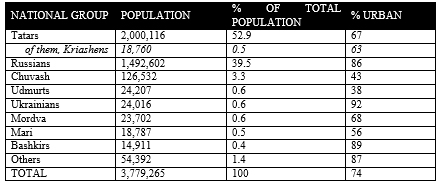
are provided for each of the republic’s eight main ethnic groups; together these
ethno-national groups comprise 98.6 percent of the republic’s total population
(see Table 2). Tatars (with the exclusion of Kriashens,
a sub-ethnic group of the Tatars that traditionally identifies with Orthodoxy)
account for nearly 99 percent of Tatarstan’s Muslims; Bashkirs, the republic’s
second-largest ethnic Muslim group, make up only 0.6 percent of the population.
Ethnic Russians, who are urbanized at a rate significantly higher than Tatars,
account for more than 86 percent of Tatarstan’s Orthodox Christians, while
Chuvash and other nationalities on the table below make up most of the
remainder.
TABLE
2: Ethno-national groups of Tatarstan
In light of the scalar issues
addressed above, it was necessary to aggregate data for 13 of the 15 cities
(with the exclusion of Tatarstan and Naberezhnye Chelny, each counted as a separate administrative district
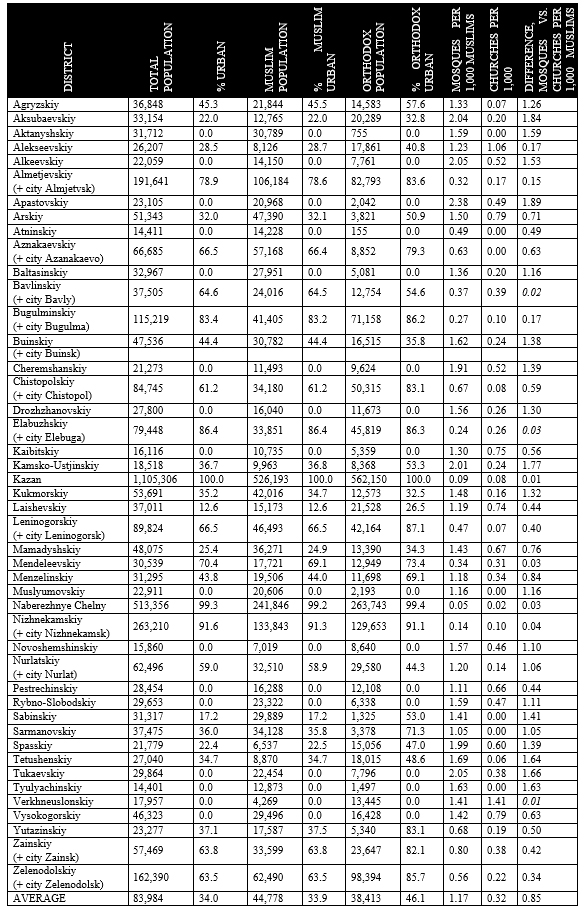
for DUMRT) with their surrounding political districts (see Table 3). Total
populations range from a high of 1.1 million (Kazan) to a low of 14,401 (Tyulyachinskiy district), with an average population of
89,984. Urban rates vary from fully urbanized (Kazan and Naberezhnye
Chelny) to completely rural (16 districts post
urbanization rates of zero). Having accomplished that task, I then aggregated
nationality population data according to religion (Muslim vs. Orthodox), as
well as urban rates for each confessional group. Finally, the number of
religious communities/organizations per 1,000 Muslims vs. Orthodox Christians
was calculated, as well as the difference between the two, for each of the 45
districts. In ration terms, the number of mosques ranges from a high of 2.38
per 1,000 Muslims in the purely rural Apostovskiy
district to a low of 0.05 in the city of Naberezhnye Chelny. For Orthodoxy, the number of organizations range
from a high of 1.41 per 1,000 Orthodox Christians to a low of 0.0 in seven
largely rural districts with small Orthodox populations.[38]
TABLE
3: Comparison of Muslim-majority regions of Russian Federation
Spatial Analysis
To
begin with the most base-level analysis, Figure 2 and Figure 3 display the
total number religious organizations against total population and the number of
religious organizations per 1,000 people against urbanization levels for each
district. One would reasonably expect to find the greatest number of religious
organizations in the districts with the greatest populations. Indeed, the
western city of Kazan is host to the greatest number of religious organizations
(n = 93). However, the second most populous district, the eastern city of Naberezhnye Chelny, has a total
of only 18 organizations, a figure among the lowest in the republic. The
southeastern district of Bulgumulskiy, a highly
urbanized area with a population among the highest in Tatarstan, also has only
18 religious communities. Instead, a crescent of three
districts—Arskiy, Kukmorskiy,
and Mamadyshskiy—north of the Volga and Kama rivers,
each with a population of only about 50,000 and urbanization rates less than 35
percent, have the second (n =71), third (n = 62), and fourth (n = 52) highest
numbers or religious communities. Zelenodolskiy (west
of Kazan) and Almetevskiy (in the center of the
republic’s southeast) are the only other higher-urbanized districts with a
population in excess of 100,000 among the top quartile in total number of
religious organizations (respectively, n = 57 and n = 48).
The
number of mosques per 1,000 appears to have a high correlation to rates of
urbanization. Districts with urbanization rates of 35 percent or lower have an
average of 1.24 religious organizations per 1,000
people, while those with urbanization rates between 36 and 68 percent have an
average of 0.82 religious organizations. Districts with an urban rate between
69 and 81 percent have an average of 0.36 religious
organizations; and those with urbanization rates in excess of 82 percent have
an average of 0.26 percent.
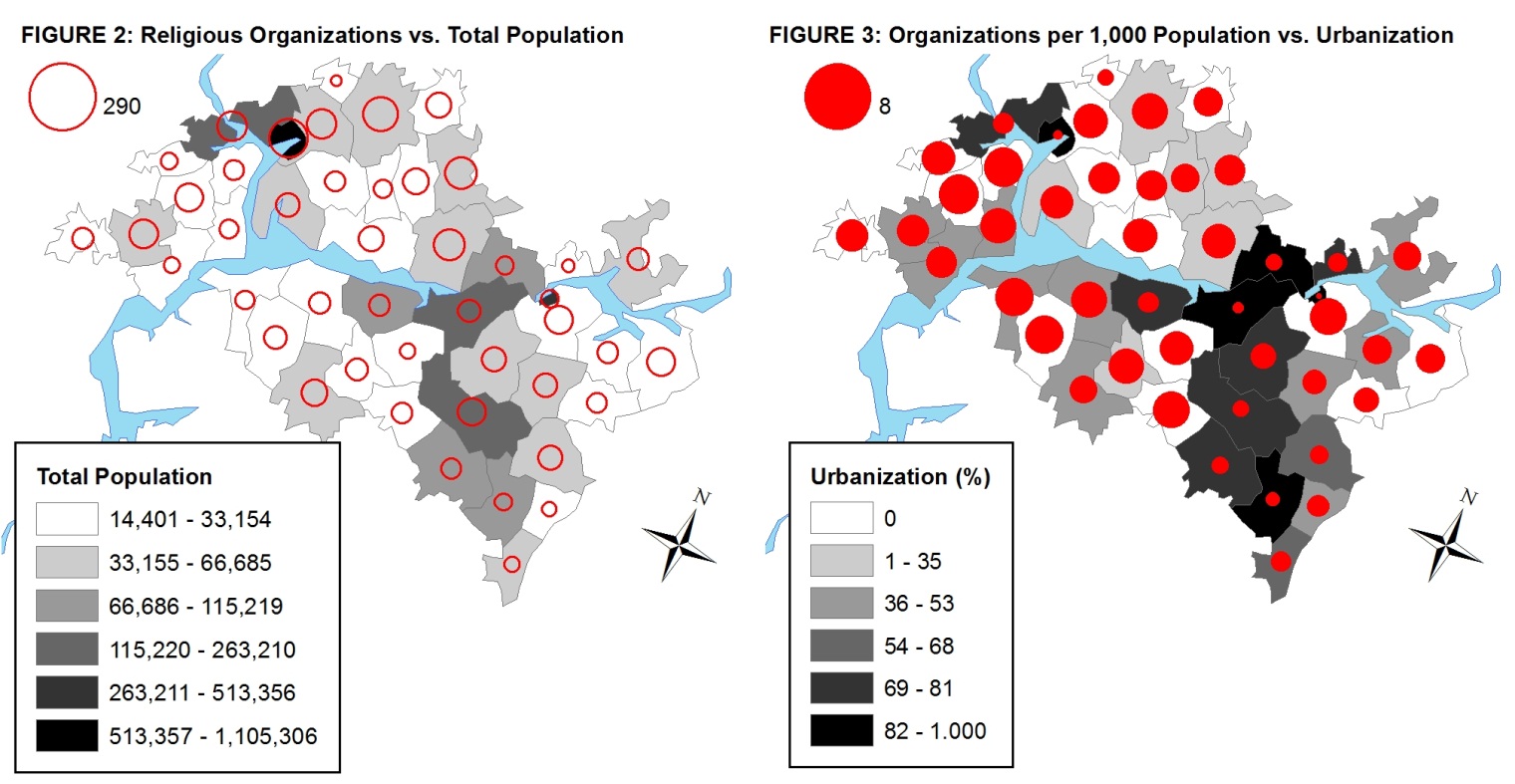
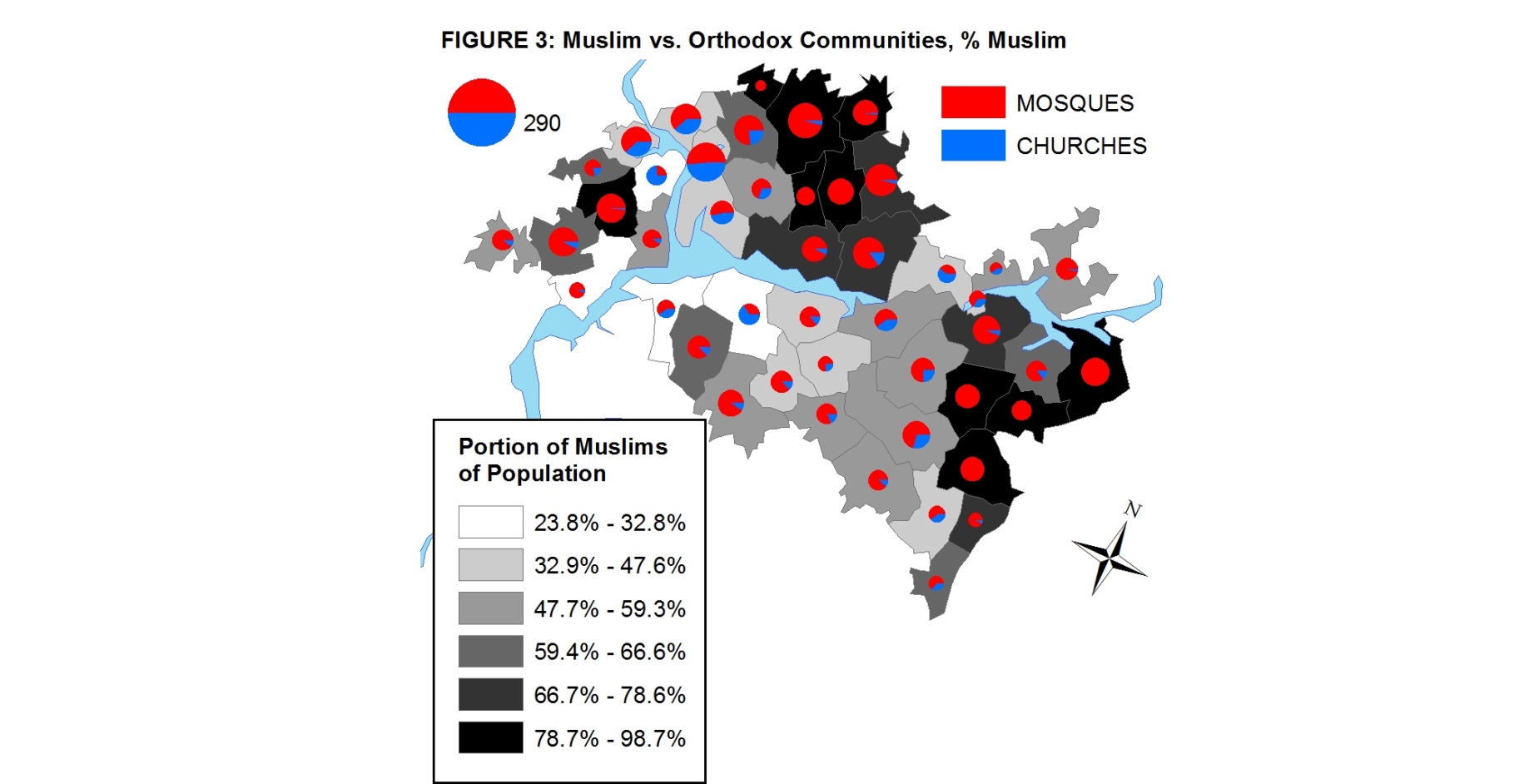
Figure 4 separates the total number
of religious organizations into Muslim and Orthodox communities, i.e. mosques
vs. churches, per district, while also displaying the percentage of Muslims
(Tatars) for each district. The north-central and far eastern districts of the
republic are overwhelmingly populated by Tatars and, consequently, host the
highest numbers of Muslim communities; there are few—and, in some cases, no—Orthodox
communities in these districts. The northern Tatar districts, as seen in Figure
3, are highly rural, as are the northeastern districts that are almost
exclusively inhabited by Tatars. Kazan and its eastern neighbor, the more rural
Laishevskiy district, which are both inhabited in
almost even numbers by Muslims and Orthodox Christians, display parity in
number of mosques and churches. The eastern urban belt running on the
north-south axis is an area of inter-confessional diversity, with proportion of
Tatars and Orthodox Christians roughly equal. However, in these areas the
number of mosques is significantly greater in each of the districts.
Turning
to Figure 5 and Figure 6, the number of mosques per 1,000 Muslims, again, is
lowest in the districts of higher urbanization. Even in rural areas where
Tatars form a minority, the number of mosques per 1,000 Muslims remains similar
to figures for rural areas dominated by Tatars. This situation for Orthodox
communities, however, is different. In the highly urbanized districts in the
east, areas of inter-religious diversity, the number of churches per 1,000
Orthodox is similarly low. But in rural districts the number of churches per
1,000 Orthodox does not maintain a relative evenness independent of Orthodox
Christians’ share of the population. In seven rural districts in
Tatar-dominated north and east, there are no Orthodox churches. In the rural
districts south of the Kama River, where there is relative parity between the
religions, the number of churches per 1,000 Orthodox is lower than the two
neighboring districts in which Orthodox form clear majorities. Across the
Volga, in the rural Tetushinskiy district, Orthodox
also comprise a clear majority, yet the district claims among the fewest
churches per 1,000 Orthodox. In short, at least in rural districts, there
appears to be more randomness in the number of churches per 1,000 Orthodox
vis-à-vis the number of mosques per 1,000 Muslims.

Concluding
Remarks
The purpose
of this article has been to offer a quantitative spatial analysis of mosques
vs. churches and their correlations to ethno-national patterns in Tatarstan,
Russia. Guiding the research and analysis is the theoretical-conceptual understanding
that the construction of religious temples does not represent an objective
reflection of new or renewed religiosity. Rather a rapid increase of religoius
temples can be understood through the lense of human territoriality, especially
in the context of an ethnically and religiously diverse post-Soviet enclave
that has been center to ethno-territorial contestation. Indeed, as discussed
above, the construction of some 1,000 mosques in Tatarstan in the first decade
after the fall of the USSR far outstripped actual reported religiosity among
the regions titular ethno-national group, and it far outpaced the (re)construction
of churches for the region’s Orthodox Russians. These imbalaces should not be
understood as accidental or coincidental, but, as asserted in this article, more
likely constitute a broader campaign to Tatarize the ethnic republic’s
landscape, communicating the primacy of Tatar ethno-national culture within the
borders of Tatarstan.
Whereas
previous contributions from social scientists most often have examined the
spatial politics of religious structures from a textual-narrative approach,
this article provides an alternative quantitative approach. Drawing on two main
datasets—a 2009 database of Muslim and Orthodox
organizations/communities (prikhody) and a 2004 database titled “National Structure of
the Population of the Republic of Tatarstan”—I utilize GIS-enabled spatial
analysis to divulge some basic correlations between the spatial patterning of
religious temples and ethno-national distributions. This paper provides a model
for future research in other parts of the post-Soviet realm, where the posited
revival of religion has been accompanied by rapid increases of construction of
mosques, churches, and other religious structures, yet has proceeded with a
spatial and temporal unevenness. Quantitative analysis in this experimental
paper is comprised of descriptive statistics. Future research could take this model
a step further in the direction of inferential spatial statistics.
[1]According to the
2010 All-Russian Census of Population, from Tatarstan’s total population of 3.8
million, Tatars account for 53.2 percent (adjusted to exclude Kriashen Tatars, a sub-group who traditionally identify
with Orthodox Christianity, the percentage of ethnic Muslim Tatars stands at
52.4%), while ethnic Russians make up 39.7 percent. The remainder of the
population almost wholly consisted of various ethnic groups who traditionally
self-identify with Orthodox Christianity.
[2]To be a Tatar
historically has meant one is a Muslim, while to be a Russian historically has
meant one is Russian Orthodox Christian, regardless of active religious
observance. In short, religious identity it tightly intertwined with
ethno-national identity.
[3]See, for example, Edward Holland
and Matthew Derrick, “From the Private to Public:
Religious Belief and Practice in Post-Soviet Russia and Central Asia,” in
Edward Holland and Matthew Derrick (eds.), Questioning
Post-Soviet (Washington, DC: Kennan Institute, 2016), pp. 75-90; Matthew
Derrick, “Territoriality and the Muslim Spiritual Boards of Russia,” in Stan Brunn (ed.), The
Changing World Religion Map (New York, NY: Springer, 2015), pp. 3017-3038;
and Matthew Derrick, “The Tension of Memory: Reclaiming the Kazan Kremlin,” Acta Slavica Iaponica, Vol.
33, No. 1 (2013), pp. 1-25.
[4] See generally
Rafael Khakim, Dzhadidizm (Reformirovannyi Islam) (Kazan: Academy
of Sciences of the Republic of Tatarstan, 2010); Damir Iskhakov,
Fenomen Tatarskogo Dzhadidizma: Vvedenie k Sotsiokul’turnomu Osmysleniiu
(Kazan: Iman, 1997). For a discussion of the role of Jadidism
in the Tatars’ national revival of the 1990s, see Azade-Ayse
Rorlich, “History, Collective Memory and Identity:
The Tatars of Sovereign Tatarstan,” Communist
and Post-Communist Studies, Vol.
32, No. 4 (1999), pp. 379-396.
[5]Rafik Mukhamethsin, a leading scholar on Islam in contemporary
Tatarstan, writes that “official” Islam in in the republic foremost is defined
by two characteristics: its apolitical nature and its loyalty to state
authorities. Rafik Mukhametshin, Islam v Tatarstane (Moscow: Logos,
2006), p. 39.
[6]See for example
Damir Iskhakov, “O sovremennom
tatarskom fundamentalizme,”
in G.F. Valeeva-Suleimanova (ed.), Iskusstvo i Etnos (Kazan: History Institute of the Academy of
Sciences of Tatarstan, 2002), pp. 121-129.
[7]Robert Sack, Human Territoriality: Its Theory and History
(Cambridge: Cambridge University Press, 1986), p. 19, emphasis in original.
[8]Ibid, pp. 32-33.
[9]Matthew
Derrick, “The Muslim Spiritual Board of Tatarstan,
Political-Territorial Transformation, and the Changing Character of Tatar
Islam,” Journal of Central Asian and
Caucasian Studies, Vol. 9, No. 18 (2014), pp. 47-80.
[10]The
construction/destruction/reconstruction religious of religious temples has been
a notable aspect of history in the Middle Volga region. After Kazan was
defeated by Muscovy in the mid-sixteenth century, Tsar Ivan IV (“the terrible”)
order the destruction of all mosques in what was formerly an Muslim citadel
(today’s Kazan Kremlin), subsequently ordered the construction of Orthodox
Christian churches, including the Annunciation Cathedral, built atop the
foundation of an important mosque and remaining in place even today. Following
Muscovy’s victory, as the Muslims were subjected to waves for forced
Christianization, state officials oversaw the decimation of mosques throughout
the region. For example, a 1744 government report boasted that 418 of 536
mosques in the region had been destroyed under the watch of the Office for the
Affairs of New Converts, created just four years earlier, while the
construction of Orthodox temples continued apace. A prohibition on mosque
construction remained in place until Empress Catherine II (“the Great”) issued
her decree on religious tolerance, once again permitting Muslims in the region
to construct mosques. On the eve of the 1917 revolution, 1,152 mosques –
approximating today’s number – were in operation in the Kazan guberniia. At the
same time, there were 794 churches, 27 cloisters, and 419 chapels under the
authority of the Kazan diocese of the Russian Orthodox Church. The formation of
the Soviet Union resulted in the decimation of temples belonging to all faiths.
While only 18 mosques were officially in operation in Tatarstan by the start of
the perestroika era, 16 Orthodox
parishes were open in the region. On the consequences of Muscovy’s defeat of
Kazan, see Galina Aidarova, “Tri perioda
iz istorii razvitiia ansamblia Kazanskogo kremlia,” in G.G. Nugmanova (ed.), Regional’noe Mnogoobrazie Arkhitektury Rossii (Kazan: Pluton, 2007), pp. 43-52; on the
destruction of mosques under Office for the Affairs of New Converts, see
Michael Khodarkovsky, “The Converstion
of Non-Christians in Early Modern Russia,” in Robert Geraci and Michael Khodarkovsky (eds.), Of
Religion and Empire: Missions, Conversion, and Tolerance in in Tsarist Russia
(Ithaca: Cornell University Press, 2001), p. 133; on the number of mosques
before the 1917 revolution, see A.B. Yunusova, Islam v Bashkirii
(Ufa: Vegu, 1994), p. 114; and for data Orthodox
churches in the region, see http://eng.kazan.eparhia.ru/.
[11]For example, see Marlene Laruelle, “The Struggle for the Soul of Tatar Islam,” in
Hillel Fradkin, Husain Haqqani and Eric Brown (eds.),
Current Trends in Islamic Ideology,
Vol. 5 (Washington, DC: Hudson Institute, 2007), pp. 26-39; Rosalina Musina, “Ethnosocial Development and Identity of Contemporary
Tatars,” Anthropology and Archeology of
Eurasia, Vol. 43, No. 2 (2004), pp. 77-93; Eduard Ponarin,
“Changing Federalism and the Islamic Challenge in Tatarstan,” Demokratizatiya,
Vol. 16, No. 3 (2008), pp. 265-276;
and Galina Yemelianova, “Islam and Nation Building in
Tatarstan and Dagestan of the Russian Federation,” Nationalities Papers, Vol. 27, No. 4 (1999), pp. 605-630.
[12]Matthew Derrick,
““Revisiting ‘Sovereign’ Tatarstan,” Journal of Central Asian and Caucasian Studies, Vol. 3, No.
6 (2008), pp. 75-103; Matthew Derrick, “The Implications of Climate Change for
Russian Geopolitics in the Arctic,” Journal of Eurasian Studies, Vol. 1, No.
2. (2009), 130-136.
[13]Mukhametshin (2006), p. 30.
[14]A refrain from
multiple key informants from my fieldwork in Tatarstan (September 2008-February
2010) was that the mosques were empty throughout the 1990s, attended only by a
small stream of elders. Data presented by Musina provide support for this
assertion. According to a 1999 survey of college-age Tatars in Tatarstan, i.e.
representatives of a generation entering adulthood in an age of religious
freedom and therefore, Musina posits, more likely to be actively religious,
fully half had never been to a mosque
for any reason, while 20 percent had been to a mosque for a religious holiday,
and another 10 percent had been to a mosque for a family event. Rozalinda Musina, “Etnosotsial’noe
razvitie i identichnost’ sovremennykh tatar,” in R.K. Urazmanova and
C.B. Cheshko (eds.), Tatary (Moscow: Nauka, 2001), p. 516.
[15]Multiple
interview subjects, including those intimately involved with the Tatarstan’s
sovereignty project, indicated that the early, rapid construction of mosques
was coordinated by the Tatar politicians with national leaders. Direct state
involvement is confirmed by Mukhametshin, who writes
that “almost all mosques in the republic, especially in villages, were built
with significant support of the local authorities ... The functioning of the
mosques more or less depended on them.” Rafik Mukhametshin,
“Ofistial’nye instituty musul’man i obschesvenno-politicheskie
organizatsii i dvizheniia,” in Rafael’ Khakimov
(ed.), Islam v Tatarskom
Mire: Istoriia i Sovremennost’ (Kazan: History Institute of the Academy
of Sciences of Tatarstan, 1997), p. 257.
[16]Anssi Paasi, “Geographical
Perspectives on Finnish National Identity,” GeoJournal, Vol. 43, No. 1
(1997), pp. 41-50.
[17]This set of data,
compiled at the district (raion) level, is based on the 2002 All-Russian Census of
Population. So far I have not been able to obtain
district-level data on nationality from Russia’s 2010 census. However, my
preliminary examination of 2010 data on the national structure of Tatarstan as
a whole indicates that no significant changes have taken place since the 2002
census.
[18]David Harvey,
“Monument and Myth,” Annals of the
Association of American Geographers, Vol. 69, No. 3 (1979), pp. 362-381
[19]Dmitri Sidorov, “National Monumentalization
and the Politics of Scale: The Resurrection of the Cathedral of Christ the
Savior in Moscow,” Annals of the
Association of American Geographers, Vol. 90, No. 3 (2000), pp. 548-572.
See also Sidorov, “Playing Chess with Churches:
Russian Orthodoxy as Re(li)gion,” Historical Geography, Vol. 28 (2000),
pp. 208-233.
[20]Kate Graney,
“Making Russia Multicultural: Kazan at Its Millennium and Beyond,” Problems of Post-Communism, Vol. 54, No.
6 (2007), pp. 17-27; see also Derrick (2013).
[21]Ibid., p. 18.
[22]Amy Mills, “Boundaries
of the Nation in the Space of the Urban: Landscape and Social Memory in
Istanbul,” Cultural Geographies, Vol.
13, No. 3 (2006), pp. 367-394. See also Mills, Streets of Memory (Athens: University of Georgia Press, 2010).
[23]See for example Argyro Loukaki, “Whose Genius
Loci? Contrasting Interpretations of the ‘Sacred Rock of the Athenian
Acropolis’,” Annals of the Association of
American Geographers, Vol. 87,
No. 2 (1997), pp. 306-329); Mohammad Al-Asad, “The
Mosque of the Turkish Grand National Assembly in Ankara: Breaking with
Tradition,” Muqarnas, Vol. 16 (1999), pp. 155-168; Kogan
Page, “The Multicultural City and the Politics of Religious Architecture: Urban
Planning, Mosques and Meaning-Making in Birmingham,” Built Environment, Vol. 30, No. 1 (2004), pp. 30-44; Sefa Şimşek, Zerrin Polvan, and Tayfun Yeşilşerit, “The Mosque as a Divisive Symbol on
the Turkish Political Landscape,” Turkish
Studies, Vol. 7, No. 3 (2006),
pp. 489-508; John Adams, “Monumentality in Urban Design: The Case of Russia,” Eurasian Geography and Economics, Vol. 49, No. 3 (2008), pp. 280-303;
Daniel Nilsson DeHanas, “Olympic Proportions: The
Expanding Scalar Politics of the London ‘Olympics Mega-Mosque’ Controversy,” Sociology, Vol. 45, No. 5 (2011), pp.
798-814; Rusmir Mahmutćehajić,
“On Ruins and the Place of Memory,” East
European Politics and Societies, Vol. 25, No. 1 (2011), pp. 153-192; and
Britt Baillie-Warren, Memorializing the
Martyred City: Negotiating Conflict-Time in Vukovar’
(Zagreb: Ivo Pilar Institute, forthcoming).
[24]Chad Emmett, “The
Siting of Churches and Mosques as an Indicator of Christian-Muslim Relations,” Islam and Christian-Muslim Relations
Vol. 20, No. 4 (2009), pp. 451-476.
[25]Robert Hayden, “Antagonist Tolerance,” Current Anthropology, Vol. 43, No. 2
(2002), pp. 205-231. See also Hayden, Hande Sözer, Tuğba Tanyeri-Erdemir, and Aykan Erdemir, “The Byzantine Mosque at Trilye:
A Processual Analysis of Dominance, Sharing, Transformation and Tolerance,” History and Anthropology, Vol. 22, No. 1
(2011), pp. 1-17. These publications are the initial results of a long-term
research project, of which Hayden is the principal investigator, titled
“Antagonistic Tolerance: An International & Interdisciplinary Project on
Competitive Sharing of Religious Sites.”
[26]Allen Frank and
Ronald Wixman, “The Middle Volga: Exploring the
Limits of Sovereignty,” in Ian Bremmer and Ray Taras
(eds.), New States, New Politics:
Building the Post-Soviet Nations (Cambridge: Cambridge University Press,
1996), pp. 140-189.
[27]See generally
I.S. Ul’ianov, Regiony Rossii: Sotsial’no-Ekonomicheskie
Pokazateli (Moscow: Rosstat,
2005).
[28]Susan Goodrich
Lehmann, “Inter-Ethnic Conflict in the Republics of Russia in Light of
Religious Revival,” Post-Soviet Geography
and Economics, Vol. 39, No. 8 (1998), p. 471.
[29]Ibid.
[30]Musina (2004), p.
89. For further illustration, see L.M. Vorontsova and
S.B. Filatov, “Religioznost’
– demokratichnost’ – avtoritarnost’,”
Polis, Vol. 3, No. 3 (1993), pp. 141-148.
[31]R.A. Silant’ev, Islam v Sovremennoi Rossii. Entsiklopediia (Moscow: Algoritm,
2008), p. 301.
[32]Ibid., p. 342.
[33]Ibid., p. 309.
[34]This latter,
lower figure is closer to more recent accounting. According to the official
website of the government of Tatarstan, as of January 1, 2012, only 1,128
Muslim religious organizations are registered in the republic, while 290
Orthodox Christian organizations are registered. Together, they account for 94
percent of a total of 1,505 religious organizations officially registered in
Tatarstan. See http://tatarstan.ru/eng/about/religion.htm.
[35]In 2003,
according to the chairman of CRA, Rinat Nabiev, the number of Muslim communities numbered
approximately 1,000, while the number of Orthodox communities was 160. Based on
these figures, the number of officially registered mosques has since grown at a
rate of approximately 10 percent, while the number of Orthodox organizations
has increased by approximately 80 percent. See Rinat Nabiev, “Vektory razvitiia Islama v Tatarstana,” in R.A. Nabiev (ed.),
Gosudarstvenno-Konfessional’noye Otnosheniia v Sovremennom Tatarstane
(Kazan: History Institute of the Academic of Sciences of the Republic of
Tatarstan, 2003), p. 28.
[36]Kazan, by far the
largest city in the republic, consists of six separate political districts (raiony), but
comprises only one administrative district (mukhtasibat) for DUMRT.
[37]Two
classifications, city (gorod)
and settlement of an urban type (posiolok gorodskogo tipa), are
factored into the urban figures.
[38]A table
containing data per national group, as well as aggregated for each confessional
group, is provided as an addendum in this paper.
*Matthew A. Derrick - Associate Professor, Humbolt State University, Department of Geography, Department Chair e-mail: mad632@humboldt.edu
© 2010, IJORS - INTERNATIONAL JOURNAL OF RUSSIAN STUDIES